

Australian payroll selection now depends on compliance controls, operational fit, and automation depth across every pay cycle. Payday Super, STP Phase 2, and criminal wage-underpayment laws have changed vendor evaluation. The Best Payroll Software in Australia shortlist must therefore reflect workforce risk rather than feature volume alone.
The Fair Work Ombudsman recovered $358 million for more than 249,000 underpaid workers during 2024–25. This result shows why leaders need accurate rules, visible exceptions and dependable evidence before approval. Every best payroll software in Australia review should test those controls through realistic payroll scenarios.
This guide compares five credible options and helps buyers match the best payroll software in Australia choice with plans for informed decision-making.
Key Takeaways
- Best Payroll Software in Australia choices depend on workforce complexity and scale.
- Payday Super increases demand for faster validation and exception handling.
- Smaller employers often prioritise setup speed and accounting integrations.
- Enterprises need much stronger compliance controls across complex multi-entity payroll workflows.
- AI tools can surface unusual movements before payroll teams approve payments.
- Cloud payroll platforms should preserve evidence across every pay cycle.
- Ramco Payce supports complex enterprise and multi-country payroll operating requirements.
- Buyers should test shortlisted vendors through realistic Australian payroll scenarios.
What Should Australian Enterprises Look ForInThe Best Payroll Software?
Australian enterprises should seek STP support, Payday Super controls, secure access and scalable integrations. The best payroll software in Australia choice must match workforce structure while identifying material exceptions before payroll closes.
- Payday Super Readiness: Software should validate contribution data, fund details, payment status and failed transactions before each payroll cycle closes. It should also help teams resolve errors quickly within the current statutory seven-business-day payment window.
- STP Phase 2 Support: Platforms should process income types, tax treatment codes, employee records and pay-event reporting with consistent accuracy. They should also support faster corrections whenever payroll classifications or employment details change unexpectedly during processing.
- Multi-Entity Architecture: Systems should support separate ABNs, payroll calendars, approval paths and consolidated governance views across the organisation. This structure helps leaders compare payroll risks between entities without relying on disconnected reports or repeated manual consolidation.
- Award and EBA Handling: Software should configure pay rules, allowances, penalty rates and agreement conditions with dependable accuracy. It should also highlight payroll exceptions early when employee circumstances or workplace terms change before the final approval stage.
- AI Anomaly Review: Reviewers should receive focused alerts for unusual pay movements that require informed human investigation. The best payroll software in Australia should help teams prioritise material exceptions while reducing low-value notifications across complex payroll cycles and large approval groups.
Why Are Australian Enterprises Reconsidering Payroll Software In 2026?
Australian enterprises are reconsidering platforms because compliance timing and risks have changed. Payday Super readiness and underpayment exposure now shape every best payroll software in Australia review before payroll closes.
- Payday Super Pressure: From 1 July 2026, employee funds must receive super contributions within seven business days after payday. The best payroll software in Australia should support validation, payment tracking, and rapid follow-up for corrections.
- Wage Underpayment Exposure: Since 1 January 2025, intentional underpayment can constitute a criminal offence. Buyers should test pay rules, exception review, approvals and audit evidence before selecting the best payroll software in Australia.
- Data Security Focus: Payroll platforms hold salary, tax, banking and identity information. The OAIC received 532 breach notifications during January to June 2025, keeping access controls central to Best Payroll Software in Australia procurement.
- AI Adoption Pressure: Gartner found that 58% of finance functions used AI during 2024. Buyers now assess AI payroll capabilities for anomaly review, reporting support and employee queries.
How Does Automated Payroll Compliance Change Manual Work?
Manual payroll can support smaller teams, although risk rises with complex awards and compressed deadlines. Automated controls validate payroll inputs before final approval decisions occur. The best payroll software in Australia assessment should examine evidence quality without removing professional responsibility.
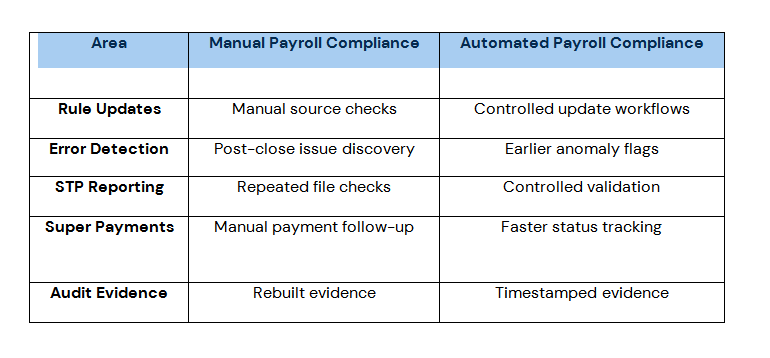
| Area | Manual Payroll Compliance | Automated Payroll Compliance |
| Rule Updates | Manual source checks | Controlled update workflows |
| Error Detection | Post-close issue discovery | Earlier anomaly flags |
| STP Reporting | Repeated file checks | Controlled validation |
| Super Payments | Manual payment follow-up | Faster status tracking |
| Audit Evidence | Rebuilt evidence | Timestamped evidence |
Effective payroll automation software should reduce rework while strengthening evidence. Payroll professionals still own source accuracy, final review and employee payment decisions.
What Are the 5 Best Payroll Software in Australia to Consider in 2026?
Here is a quick overview of the best payroll software in Australia that enterprises can consider in 2026:
| Criterion | Ramco Payce | ADP | Dayforce | Employment Hero | SAP SuccessFactors |
| Target Segment | Global enterprise | Mid-large | Mid-large | SME and mid-market | SAP customers |
| Australian Fit | STP and super | Australian services | Australian payroll | Awards plus STP | Australian localisation |
| AI Capability | BInGO and Chia | Analytics options | HCM analytics | Automation | SAP AI |
| Service Model | Software or managed | Software or outsourcing | Unified HCM | HR and payroll | SAP HCM |
| Expansion Fit | Strong global design | Global presence | Global HCM | Selected markets | SAP-led global fit |
The leading platforms serve different buyer profiles and operating models. Some prioritise Australian award coverage, while others support enterprise governance and multi-country payroll. This review compares each option based on its features, strengths, limitations, and most suitable use case.
1. Ramco Payce
Ramco Payce combines enterprise payroll processing, AI-assisted review, employee services, and managed payroll support into a single platform. It targets medium, large, multi-entity and multi-country organisations that need stronger control across complex pay runs. Australian teams can manage compliance, exceptions, reporting and expansion without relying on fragmented payroll processes.
What Are the Key Features of Ramco Payce?
- Payroll Workspace brings inputs, integrations, anomalies, processing tasks, and reports into a single console.
- BInGO creates on-demand payroll reports and conversational insights without requiring specialist coding knowledge.
- Chia provides continuous payroll and HR assistance through supported employee communication channels.
- Managed Services add processing capacity, compliance support, service continuity and structured governance.
- Australian workflows support STP reporting, PAYG calculations, superannuation processing and audit evidence requirements.
- Global payroll capabilities support localised compliance across more than 150 countries worldwide.
What Are the Pros and Cons of Ramco Payce?
| Pros | Cons |
| Strong enterprise payroll processing controls | May exceed very small business needs |
| AI-supported anomaly and reporting capabilities | Implementation requires careful change planning |
| Managed services and software together | |
| Multi-country payroll across 150-plus countries |
Who Is Ramco Payce Best Suited To?
Ramco Payce best suits medium, large, multi-entity, and multi-country organisations that manage payroll operations. It fits teams that need enterprise control, managed-service flexibility, AI-supported review, and consolidated visibility across jurisdictions worldwide.
What Should Buyers Assess Before Choosing Ramco Payce?
Buyers should assess implementation scope, source data quality, integration requirements, and change readiness before making a selection. They should also confirm service responsibilities, reporting expectations, approval ownership and governance requirements during procurement planning.
Read More: What are major issues hotels face and how to overcome them?
2. ADP Payroll
ADP provides payroll software and managed outsourcing services for organisations of all sizes. It also supports international payroll operations and broader workforce management requirements. Australian customers can retain selected responsibilities or transfer wider processing activities to ADP specialists. This model suits buyers that value provider experience, compliance support, cloud access and service flexibility.
What Are the Key Features of ADP Payroll?
- Managed payroll services handle processing, PAYG calculations, superannuation payments and STP submissions.
- Cloud access gives authorised teams continuous remote visibility into current payroll information.
- Employee self-service supports payslip access, leave management, tax information and payroll requests.
- Flexible processing models let internal teams retain selected payroll responsibilities and control.
What Are the Pros and Cons of ADP Payroll?
| Pros | Cons |
| Established global payroll provider experience | Product selection requires careful scoping |
| Flexible managed and processing models | Reporting depth can vary by service |
| Australian compliance and STP support | Implementation depends on selected configuration |
Who Is ADP Payroll Best Suited To?
ADP is best suited to organisations seeking an established payroll provider with Australian compliance support. It fits buyers wanting cloud software, flexible outsourcing, service support and coverage across workforce sizes and markets.
What Should Buyers Assess Before Choosing ADP Payroll?
Buyers should identify the ADP product and service tier that best matches their workforce requirements. They should confirm implementation ownership, reporting depth, integration responsibilities and employee support boundaries before final contracting decisions.
3. Dayforce
Dayforce combines payroll and workforce management within a single cloud-based HCM platform. Its Australian payroll capability supports employee pay, PAYG tax, superannuation processing and related requirements. Organisations can connect time data and workforce information with payroll processing. This structure suits buyers seeking fewer system handoffs across complex workforce operations today.
What Are the Key Features of Dayforce?
- Unified time and pay data reduces handoffs across connected workforce management processes.
- Continuous calculation helps teams review payroll changes throughout each active processing cycle.
- Employee self-service provides secure access through supported web and mobile experiences.
What Are the Pros and Cons of Dayforce?
| Pros | Cons |
| Unified payroll and workforce management | Implementation may require significant resources |
| Australian PAYG and super support | Broader HCM scope may add complexity |
| Connected time and payroll data | Smaller teams may need fewer capabilities |
Who Is Dayforce Best Suited To?
Dayforce best suits mid-sized and large organisations seeking payroll with workforce management. It fits teams where connected data supports payroll accuracy, operational control, workforce planning and compliance visibility at scale.
What Should Buyers Assess Before Choosing Dayforce?
Buyers should assess implementation capacity, existing HR architecture, integration requirements and change readiness. They should also confirm Australian configuration scope, reporting depth, service expectations and international coverage across expansion markets.
4. Employment Hero Payroll
Employment Hero combines Australian payroll capabilities with connected HR workflows and automated award interpretation. The platform calculates pay conditions across supported modern awards and enterprise agreements. It also connects timesheets, leave, employee records and payroll processing. This approach suits smaller and mid-market employers seeking accessible workforce administration in a single environment.
What Are the Key Features of Employment Hero Payroll?
- Automated award interpretation accurately calculates pay rates, allowances, overtime, and employee entitlements.
- Pre-built awards and configurable agreements support different Australian workplace conditions and requirements.
- Timesheet interpretation calculates labour costs before teams finalise each scheduled pay run.
- Connected HR workflows link leave, timesheets, employee records and payroll processing activities.
What Are the Pros and Cons of Employment Hero Payroll?
| Pros | Cons |
| Strong Australian award interpretation support | Enterprise scalability needs careful assessment |
| Connected HR and payroll workflows | Award configuration requires accurate setup |
| Accessible fit for growing employers | Reporting depth may vary by plan |
Who Is Employment Hero Payroll Best Suited To?
Employment Hero best suits small and mid-sized Australian employers seeking connected HR and payroll workflows. It fits teams needing automated award interpretation and accessible tools for common workforce administration requirements.
What Should Buyers Assess Before Choosing Employment Hero Payroll?
Buyers should confirm supported awards, agreement configuration, reporting depth and expected employee scale. They should also assess service inclusions, integration requirements, governance controls, and future organisational scaling requirements before making a selection.
5. SAP SuccessFactors Employee Central Payroll
SAP SuccessFactors Employee Central Payroll connects enterprise payroll with SAP’s wider HCM ecosystem through prebuilt integrations. The platform supports continuous processing, anomaly detection, real-time insights and guided issue resolution across supported countries. It suits organisations using SAP SuccessFactors that want payroll data, workforce information, financial connections and common governance within a single architecture.
What Are the Key Features of SAP SuccessFactors Employee Central Payroll?
- Continuous payroll identifies data changes and anomalies before teams complete final processing.
- Localised payroll compliance supports regulations and tax requirements across sixty supported countries.
- Explain Pay provides employees with personalised payroll assistance through AI-supported digital experiences.
What Are the Pros and Cons of SAP SuccessFactors Employee Central Payroll?
| Pros | Cons |
| Strong fit within SAP environments | Implementation requires specialist SAP capability |
| Continuous payroll and anomaly detection | Non-SAP integrations may require effort |
| Localisation across sixty supported countries | Broader ecosystem can increase complexity |
Who Is SAP Success Factors Employee Central Payroll Best Suited To?
SAP Success Factors Employee Central Payroll is best suited to large enterprises already using SAP HCM. It fits teams that need continuous processing, integrated workforce data, localised payroll, and SAP-aligned governance across countries worldwide.
What Should Buyers Assess Before Choosing SAP Payroll?
Buyers should assess SAP architecture, specialist capability, implementation effort and integration costs. Organisations using other HCM platforms should compare long-term fit before committing to SAP-centred payroll operations and governance requirements.
How Do AI-Powered Payroll Tools Change Software Selection?
AI matters because large pay runs generate more exceptions than reviewers can manually inspect. In November 2025, Gartner reported 58% AI adoption across finance functions. The Best Payroll Software in Australia review should test whether AI directs attention towards meaningful risks.
Anomaly engines compare current results with historical payroll patterns before approval. Earlier investigation is crucial when Payday Super compresses correction windows, and underpayment exposure demands stronger evidence.
Employee assistants can manage routine questions during EOFY, STP finalisation and major payroll changes. Effective AI payroll capabilities support query handling and reporting without replacing professional judgement. Payroll leaders still approve every material decision affecting individual employee pay.
Conclusion: Why Consider Ramco Payce for Enterprise Payroll in Australia?
For Australian organisations, choosing a payroll platform comes down to how well it can handle the realities of your workforce, compliance requirements, and day-to-day payroll operations. Ramco Payce is worth considering if you are looking to reduce manual effort, improve payroll visibility, and have stronger controls as your payroll environment becomes more complex.
However, every organisation has different payroll processes and requirements. The best approach is to book a demo with the Ramco team and discuss your specific payroll setup. You can explore the platform, understand how it would fit into your existing processes, and assess the feasibility before making a decision.
If you are reviewing payroll solutions for your organisation, take a closer look at Ramco Payce, speak with the team, and see whether it is the right fit for your business.
Read More: The Best Solutions for Ease of Workforce Management with Future Ready HR Software in 2025
Frequently Asked Questions
Which Payroll Software Is Best for Australian Compliance?
The best payroll software in Australia decision depends on workforce size, award complexity, STP requirements and super workflows. Buyers should test representative employees and reporting scenarios before selection. Strong payroll compliance software should preserve evidence while qualified leaders retain final responsibility.
What is the Best Payroll Software for Small Business in Australia?
Smaller teams often value fast setup, accounting connections, STP reporting and accessible support. Enterprise platforms address deeper governance and complex multi-country operating requirements. Buyers should compare the best payroll software options in Australia against realistic employee numbers, award complexity, and expected growth.
Why Does Payday Super Change Payroll Software Selection?
Payday Super links contribution activity with every payroll cycle from 1 July 2026. Software should validate contribution data and surface failed payments quickly. The best payroll software in Australia choice must support action within the seven-business-day receipt deadline.
How Important is STP Phase 2 In Payroll Software Comparison?
STP Phase 2 sends expanded payroll information to the ATO through every pay event. Buyers should test income types, tax treatment codes and employee records. The best payroll software in Australia platform should support accurate submissions and clear correction workflows.
Do AI-Powered Payroll Tools Replace Payroll Teams?
AI supports anomaly review, routine queries and faster reporting across higher transaction volumes. It does not own employee classifications or final payment decisions. The best payroll software in Australia should keep qualified professionals accountable for pay-affecting outcomes.
How Should Enterprises Compare Payroll Software Pricing?
Enterprises should compare subscriptions, implementation, integrations, support models and expected manual rework. They should also assess future compliance exposure and international expansion costs. The best payroll software in Australia choice should deliver sustainable value rather than the lowest initial price.













+ There are no comments
Add yours